

Drafting and redrafting
Drafting and redrafting is a crucial aspect of writing and one that English students should be taught to embrace. This process helps students to refine their writing, making it clearer, more concise, and more effective. By taking the time to revise and refine their writing, students can develop a critical eye for their own writing and make meaningful improvements over time.
‘Good writers usually stop periodically to re-read, reflect, perhaps look back at the original plan, sometimes re-plan, and then work out how to express the next set of ideas’ Hedge; 2005
One of the key benefits of drafting and redrafting is that it allows students to identify and correct mistakes in their writing. This is especially important in exam writing tasks where every mark counts and mistakes can cost students valuable points. By taking the time to draft and redraft, students can catch spelling and grammar errors, as well as improve the flow and structure of their writing.
Another benefit of drafting and redrafting is that it allows students to develop their voice and style. As they revise and refine their writing, students can experiment with different approaches, styles, and tone, until they find the one that best suits their writing goals. This process can help students to develop a unique and distinct writing style, which is an important aspect of writing that can help to set them apart from others.
It’s important to note that drafting and redrafting is not just important in exam writing tasks, but in any writing task in general. Whether students are writing an essay, a job application, or even an email, taking the time to draft and redraft can help them to produce better, more effective writing.
Using vocabulary checkers
Using complex vocabulary is a key aspect of writing that can make a big difference between a pass and a fail for English students. Vocabulary plays a vital role in determining the overall quality and effectiveness of writing. The use of high-level vocabulary shows a mastery of the language and a sophisticated understanding of its nuances. This is especially important in exam writing tasks where every mark counts and students need to demonstrate their mastery of the language.
To help English students improve their vocabulary, there are online websites that classify vocabulary by their CEFR (Common European Framework of Reference for Languages) level.

https://www.englishprofile.org/wordlists/evp
https://dictionary.cambridge.org/dictionary/learner-english/
https://www.english.com/gse/teacher-toolkit/user/vocabulary
These websites allow students to identify the level of their vocabulary and make improvements accordingly. For example, if a student’s writing is at a B1 level, they can use the website to find vocabulary that is appropriate for a B2 or C1 level and start incorporating it into their writing. This can make a big difference in the quality of their writing and can surprise the teacher or examiner.
Students can also make vocabulary lists in their physical or online notebooks of all the higher level vocabulary they are finding. Teachers should encourage them to regularly review and use this higher level language not only in speaking tasks but also writing ones.
Using text checkers
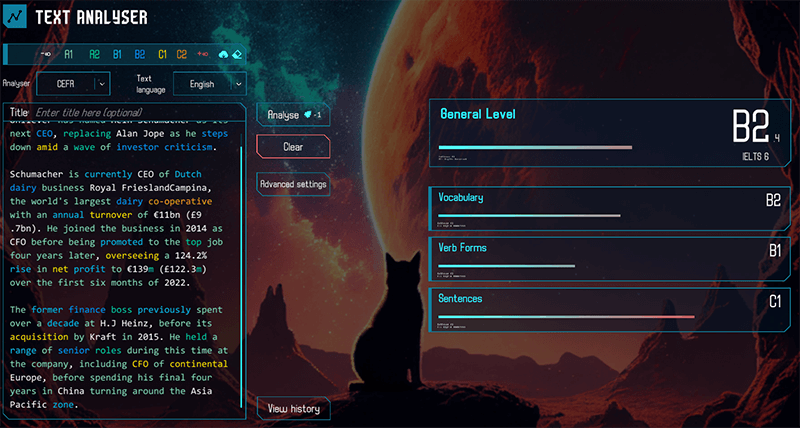
Another useful tool for English students looking to improve their writing is the use of CEFR text checkers. These online tools give the whole text a CEFR level based on a range of factors such as vocabulary, grammar, and writing structure. This allows students to see how their writing stacks up against the CEFR levels and identify areas where they need to make improvements.
http://www.roadtogrammar.com/textanalysis/
https://languageresearch.cambridge.org/wordlists/text-inspector
https://hub.cathoven.com/?scene=analyser&core=cefr
By using CEFR text checkers, students can pinpoint problem areas in their writing, such as weak or low-level vocabulary or structures. This can be a great way to identify areas for improvement, as students can see exactly where their writing is lacking and what they need to work on. For example, if a text is consistently being classified as having a lower CEFR level, students can use the tool to identify areas where they are using weak or low-level vocabulary or structures, and make the necessary improvements to bring their writing up to the next level.
Another advantage of using CEFR text checkers is that they provide a great way to compare low and high-level texts. Students can use the tool to compare their own writing with texts written at a higher level and see exactly how the language differs. This can be a great way for students to learn and gain inspiration for their own writing. By seeing the differences between low and high-level texts, students can gain a better understanding of what it takes to achieve a higher level of writing, and what they need to do to get there.
Make students responsible
By following the advice in this post, getting students to draft their writing, isolate and learn individual words that are higher level and also classify their text as a whole, you can empower your students to improve their writing ten-fold.
If you want to learn more about how online tools and tech can help you in the classroom, then check out my YouTube channel, Charlie’s Lessons, right here: https://www.youtube.com/c/CharliesLessons








Great post!
Thanks for sharing!