
Lesson planning has never really been the same experience for everyone. Some teachers enjoy the process, they sit down, take their time, think through the lesson, imagine how students might react, and build something that feels quite personal. Others just want something solid that works, especially after a long day when the last thing they want is to stare at a blank page and start from zero.
Now AI is part of the picture, and it changes that starting point completely.
Instead of building everything from scratch, you type a few lines and suddenly there’s a full lesson in front of you. It looks organised, it has a clear flow, and it gives you the feeling that you’re already halfway there. On a busy day, that can feel like a huge relief.
At first, it seems like the perfect solution. And in some ways, it really is helpful. But after using it a few times, you start to realise that it doesn’t remove the work, it just moves it somewhere else.
Why Teachers Are Using AI More
It mostly comes down to time and mental energy.
Planning is not just about writing activities. You’re thinking about a real group of people. Their level, their attention span, what usually confuses them, what keeps them engaged, how quickly they move through tasks. That kind of thinking takes effort, and it’s not always easy to do well when you’re tired.
So when AI gives you something instantly, it removes that heavy first step. You’re no longer starting from nothing, you’re reacting to something that already exists. Even if you don’t use it exactly as it is, it gives you direction.
There is also something reassuring about seeing a full lesson appear so quickly. It creates the sense that things are under control, even if you still need to adjust quite a bit.
Where AI Actually Helps
One of the most useful things AI does is give you a structure when your mind is not fully there. You might not follow it exactly, but it helps you organise your ideas faster.
It can also push you slightly out of your usual way of teaching. Not in a dramatic way, but enough to make you pause and think, maybe I could approach this differently. Sometimes that’s all you need to refresh a lesson that was starting to feel repetitive.
It’s also practical when you need to adapt something quickly. If a task feels too easy or too difficult, you can reshape it in seconds instead of reworking the whole lesson.
So in that sense, AI is less about replacing planning and more about making it feel lighter.
Where It Starts to Feel Off
After a while, there’s usually a moment where you read a lesson and think, this looks fine, but it doesn’t really feel like my class.
That’s because AI doesn’t know the details that actually make a lesson work. It doesn’t know who avoids speaking unless encouraged, who finishes everything too quickly, or which topics your students connect with naturally.
The lesson can look complete, but still feel slightly disconnected from the reality of the room.
There is also something more subtle that starts to happen over time. When AI becomes your main way of planning, you stop questioning things as much. You begin to accept ideas more quickly instead of shaping them. Planning becomes more about choosing than thinking, and that changes the process more than people expect.
The Reality of the Classroom
Another thing that becomes obvious quite quickly is that lessons rarely go the way they look on paper.
Students take longer to understand instructions, conversations go in unexpected directions, some activities work better than expected, others don’t land at all. That unpredictability is part of teaching.
AI doesn’t really account for that. It gives you a clean version of a lesson, but real classes are rarely that smooth.
So if you follow it too closely, you can end up with something that feels rushed or overloaded, even if it looked perfectly balanced when you first read it.
What Makes It Work
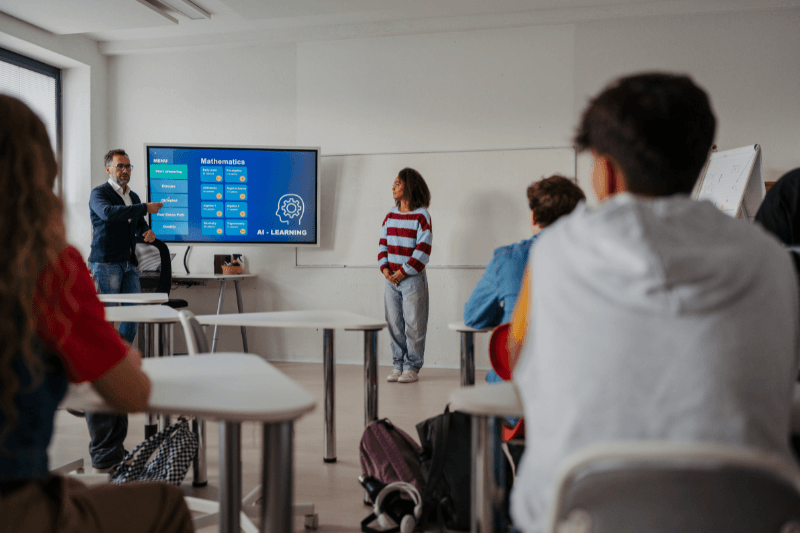
The teachers who actually get something out of AI don’t treat it as a finished lesson. They read it, take what makes sense, and reshape it based on how their class really is.
A task might seem fine at first, but then you realise your students won’t connect with the topic, so you change it. Or something feels too long, so you cut it down before it becomes a problem. Sometimes you keep just one idea from the whole plan and build everything else around it in your own way.
After a bit of adjustment, it stops feeling like something generated by a tool and starts feeling like something you would actually teach. That’s usually when it becomes useful.
The Human Part Doesn’t Disappear
Once you’ve been teaching for a while, you realise that lessons don’t work just because they are well structured, but also because they fit the group in front of you.
You can have a carefully planned lesson that feels flat, and a simple one that works really well because it connects with the students.
That ability to read the room, to adjust in the moment, to know when to push and when to slow down, that doesn’t come from any tool.
AI can support what happens before the lesson, but it doesn’t replace what happens during it.
For New Teachers, It’s a Bit of a Balance
If you’re just starting out, AI can feel like a safety net. It gives you something to work with, especially when you’re still figuring out how lessons are built.
At the same time, this is also when you learn the most by planning things yourself. Even if it takes longer, that process helps you understand why certain ideas work and others don’t.
If AI does too much of that thinking early on, it can slow down that learning without you realising it.
So it’s less like avoiding AI and more of not letting it take over completely.

So Where Does That Leave Us
AI hasn’t removed the need for lesson planning. It has just changed how the process begins.
Instead of building everything from zero, you start with something and shape it into what your class actually needs.
If you use it without thinking, lessons can start to feel generic. If you use it with intention, it can make planning faster and sometimes even more creative.
The difference is not in the tool, it’s in how much of your own thinking stays in the process.
Because in the end, a lesson only works when it makes sense for the people sitting in front of you. And that part is still entirely human.





Leave A Comment